
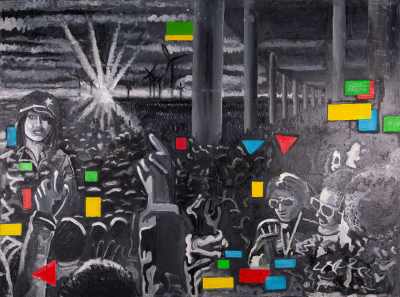
The Rave Beneath the Motorway
A work of art such as ‘The Rave Beneath the Motorway’ mirrors the elements missing from our current society. It stands as a beacon of hope on the edge of a city, in a space where established venues often fail to accommodate the marginalised. This art doesn’t just aim to inspire; it seeks to ignite the fire of unity and inclusivity that characterised the 90s rave scene—a time when people came together regardless of status.
Industrialisation and the Shift in Society
The industrialisation of the 1780s brought a seismic shift in how we live. As cities beckoned the impoverished—including my own ancestors in Wales and Ireland—people sought refuge from the toil of agriculture in hopes of a better life. This era created a stark contrast between the prosperous and the marginalised, as rural traditions were traded for the grit of burgeoning urban centres.
While competition is often framed as the natural order, it is not the only narrative. Darwin’s theories have their place, but Cooperation Theory reminds us of the importance of social bonds. These bonds connect us to a larger story and can guide us toward a more compassionate society.
A Call for Compassion
Our modern fixation on success often leaves the less fortunate behind—those with mental health challenges, the unsupported, and those facing economic hardship due to disability. The marginalised are a diverse group, but they often share the commonality of poverty. Not everyone has a supportive family to rely on, and labelling those unable to work as “burdens” is deeply unjust.
The 1930s Great Depression serves as a stark historical reminder of how economic downturns devastate lives. It underscores the urgent need for a society that values cooperation over cold competition, ensuring that the few do not thrive while the many languish.